Outback Steakhouse is withdrawing, but it’s not leaving. silently and purposefully. In October 2025, Bloomin’ Brands closed 21 of its restaurants, many of which were Outback locations, and indicated plans to let more leases expire over the following few years. When the move occurred, there was no celebration or even an apology to loyal consumers. It was only announced as part of a broader realignment strategy.
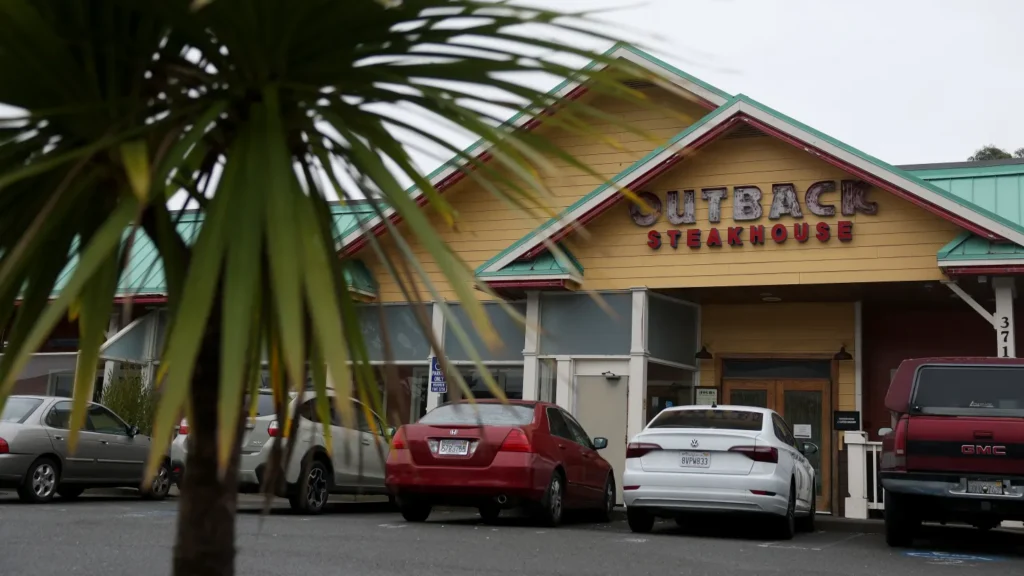
Despite their seeming abruptness, the closures are part of a $75 million effort to stabilize the company’s long-term performance. Outback, Bloomin’s most well-known brand, is anticipated to receive $50 million of that investment. It is expected that this money will be utilized to fund significant improvements and revamp its menus, demonstrating an effort to stay current rather than become antiquated.
| Item | Details |
|---|---|
| Parent Company | Bloomin’ Brands |
| Chains Affected | Outback Steakhouse, Bonefish Grill, Carrabba’s Italian Grill |
| Closures Announced | 21 restaurants in October 2025 |
| Planned Lease Non-Renewals | Additional locations identified over the next four years |
| Investment Plan | $75 million turnaround strategy across brands |
| Outback Allocation | $50 million for remodels and menu improvements |
| Legal Case | $50K injury lawsuit tied to Florida Outback restroom incident |
| Source |
In recent years, the informal dining environment has become more severe. Customers seek consistency and ambiance more than just a well-known brand. Two of Outback’s competitors, Texas Roadhouse and Longhorn, have demonstrated remarkably effective strategies that depend on operational efficacy and genuineness. They have expanded both strategically and steadily.
Outback, on the other hand, seemed to be caught between two eras. The Australian-inspired concept appeared fresh and fun at one point. It sounds dramatic and unclear now. Relevance is a bigger issue for the organization than size, even though it still has hundreds of locations around the nation. Diners are increasingly drawn to spaces that feel contemporary, personal, and anchored in a unique character. Steak and shrimp are still popular, but only when paired with an unforgettable event.
During the November earnings call, Bloomin’ Brands executives announced their plans to enhance the in-restaurant experience, close underperforming locations, and invest in more robust markets. This strategy could be very helpful for Outback if used properly. Actually, fewer shops could allow for more focused innovation, especially if each remodeling appropriately reflects changing customer needs.
But just as the brand was starting to advance, an outdated problem—this time from a restroom stall—arose. A Florida man’s $50,000 complaint claims that he was injured when a toilet fell beneath him at an Ocala Outback store. The claim has gained attention at a time when looks are crucial, even though it has nothing to do with food or service. Even if the suit is quite inexpensive, the timing couldn’t be worse. For a company that is making a lot of effort to look fresh, this felt a lot like a reminder that the basics are still crucial.
It was a strange moment to pause and think about how something as insignificant as keeping up a restroom might lead to a series of legal and PR problems. That’s when I realized how often small clues that either build or break trust determine how people perceive a brand.
However, one faulty toilet does not bring down a $50 million plan. Enhancing Outback’s infrastructure, reputation, and experience is still the main objective. From the table lighting to the entrée plating, there is much room for improvement. By using customer feedback, new analytics tools, and an updated cooking plan, the company has the opportunity to reposition itself as a modern, enjoyable eating experience rather than just a legacy brand.
A menu with an eye toward the future might bridge that divide. It is common for chains to appeal to younger generations without losing their main customer base by adapting to nutritional shifts in the casual steakhouse industry, such as plant-forward cuisine, gluten-free alternatives, or sharing platters. A reimagined Bloomin’ Onion or a steak that is obtained ethically might be both a symbol of progress and a nod to history.
Optimizing layouts and reducing square footage can make each location more cost-effective from an operating perspective. Bloomin’ may greatly improve service quality while reducing worker friction by incorporating cutting-edge solutions like efficient ordering platforms and updated training models. This is especially important at a time when many restaurants are still having trouble hiring.
Notably, Outback continues to evoke strong feelings in many Americans. It was the place for casual birthday parties, romantic evenings, or a midweek dinner that was a bit more elegant than fast food. The foundation of goodwill that this familiarity offers should not be undervalued. A rejuvenated experience that retains just enough of its core elements could be a highly reliable recipe for a resurgence.
The hard part now is, of course, execution. Transforming dozens of locations, managing vendor schedules, matching branding, and training employees while maintaining consistent service is a high-stakes balancing act. It’s encouraging, though, that the plan shows Bloomin’ is keeping its flagship. Instead, it is choosing to restructure it using more focused criteria.