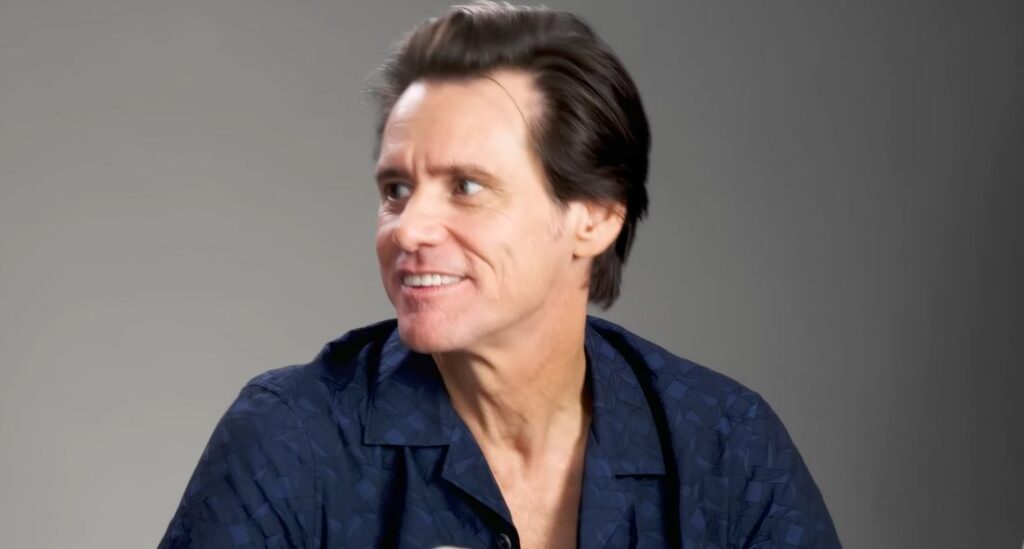
Jim Carrey’s estimated net worth in 2025 is $180 million, which is significantly less than his once enormous $300 million fortune but still represents his extraordinary creative success. His journey from sleeping in a van with his family to becoming one of Hollywood’s highest-paid performers is still incredibly motivating.
Carrey’s early life was influenced by hardship. After his father lost his job, he and his family spent nights cleaning factories while he was growing up in Ontario. Instead of shattering him, that challenging chapter stoked an atypically intense drive. At the age of 15, he began doing stand-up in Toronto clubs, where he honed his elastic comedic style that would eventually win over millions of fans.
| Category | Information |
|---|---|
| Full Name | James Eugene Carrey |
| Date of Birth | January 17, 1962 |
| Birthplace | Newmarket, Ontario, Canada |
| Nationality | Canadian-American |
| Age (2025) | 63 years |
| Occupations | Actor, Comedian, Producer, Painter |
| Net Worth (2025) | Estimated $180 million |
| Peak Net Worth | Around $300 million |
| Active Years | 1977 – Present |
| Notable Films | The Mask, Ace Ventura, The Truman Show, Bruce Almighty, Eternal Sunshine of the Spotless Mind |
| Awards | 2 Golden Globes, multiple BAFTA and SAG nominations |
| Marriages | Melissa Womer (1987–1995), Lauren Holly (1996–1997) |
| Children | Jane Erin Carrey |
| Current Residence | Maui, Hawaii |
| Reference | Celebrity Net Worth – Jim Carrey |
Legendary comedian Rodney Dangerfield saw Carrey’s natural mimicry and unparalleled energy and decided to take him on tour. Hollywood’s doors were opened by this incredibly successful opportunity. After making an appearance on In Living Color, the sketch show that paved the way for his quick ascent, Carrey went from being a Canadian stand-up comedian to an American household name by the early 1990s.
Then came 1994, the year that brought about all the changes. Carrey produced three consecutive blockbusters in a matter of months: Dumb and Dumber, The Mask, and Ace Ventura: Pet Detective. With each earning over $100 million worldwide, the 32-year-old became a movie star. Seldom have actors gone through such a dramatic rise. It was like watching a living cartoon redefine comedy because of his charisma and rubber-faced expressiveness, which seemed almost superhuman.
The financial transformation that ensued was equally astounding. Carrey became the first actor to earn $20 million up front for The Cable Guy in 1996. In addition to signifying his fame, his record-breaking pay also represented a change in Hollywood’s perception of comedy. Carrey’s salary put him in the same league as Tom Cruise and Tom Hanks because it was much more than most dramatic actors made at the time.
His income was remarkably steady throughout the late 1990s and early 2000s. He made at least $20 million from movies like Liar Liar, How the Grinch Stole Christmas, and Me, Myself & Irene. Later, he made over $35 million from Yes Man thanks to a profit-sharing arrangement. He gave up his base pay in exchange for a portion of the movie’s earnings, which was a very creative arrangement that worked wonders when the film became a worldwide success.
However, Carrey’s legacy goes beyond statistics. His shift into drama with Eternal Sunshine of the Spotless Mind and The Truman Show exposed a more profound, reflective performer. He received Golden Globes and critical acclaim for these films, which put him in the company of performers who successfully combined intelligence and passion. He was more than just a clown; he was an artist who used melancholy and humor to explore the human condition.
Carrey’s earnings from film alone totaled over $300 million by 2010. But in the years that followed, he made different decisions. Once his playground, fame started to feel restrictive. He left the chaos of Hollywood to concentrate on painting and spirituality. His artwork became a new kind of storytelling because it was remarkably similar to his comedic style, which is bold, expressive, and sometimes surreal.
He declared a near-retirement in 2022, claiming to have “enough.” A man who had transcended his industry was reflected in that statement, which was both defiant and peaceful. However, Carrey made a comeback two years later, playing Dr. Robotnik in Sonic the Hedgehog 3. “I need the money,” he joked when asked why. Although amusing, the statement also encapsulated the dilemma faced by a performer who must choose between simplicity and spectacle.
Carrey’s financial situation is still very stable. Even though his wealth has decreased, it is still maintained by wise investments, art sales, and residuals from decades of internationally syndicated movies. His 2024 sale of his Brentwood mansion, which was originally listed for $28.9 million but ended up selling for $17 million, represented both a personal development and a downsizing. He embodied a quiet wealth that feels refreshingly human by moving to Maui and trading glamour for tranquility.
Carrey is seen by colleagues in the industry as both a mentor and an outlier. His co-star in Mask, Cameron Diaz, once called him “lightning in a bottle.” He is credited by directors such as Tom Shadyac with transforming studio comedy into something that has emotional resonance. His influence can be observed in contemporary actors who strike a balance between depth and absurdity, such as Adam Sandler and Ryan Reynolds.
Carrey’s life story also highlights a crucial social discussion about how creative individuals redefine success after reaching the pinnacle of fame. His withdrawal into introspection, art, and selective film selections reflects a larger tendency among artists who prioritize meaning over financial gain. In this way, younger creatives can learn from Carrey’s story that fulfillment frequently lies outside of visibility.
In contrast to other legendary comedians, Carrey’s financial trajectory is still distinct. Carrey employed restraint as a tactic, while Robin Williams and Eddie Murphy ventured into voice acting and franchises. Ironically, his absence maintained his mystique, making his name iconic while others faded under excessive exposure. His legacy feels timeless rather than out of date because of how resilient that restraint has proven to be.
Socially, his artwork has spurred discussions about politics, mental health, and the demands of fame. His paintings, which are frequently scathing indictments of celebrity and power, are now more expressions of liberation than rebellion. Carrey shows that success can last long after the box office lights go out with this creative evolution.
Carrey’s longevity seems especially remarkable in the current entertainment landscape, where content is quickly absorbed and forgotten. His career was founded on humor, which he later reinterpreted via self-examination. Significant but secondary, his wealth is evidence of a life shaped more by purpose than by financial gain.
The symbolism is still powerful for an actor who once wrote a check for $10 million before he had a single film credit. Carrey lived every word of that check, in addition to cashing it. His greatest wealth, however, may not be in his bank account but rather in the freedom he has gained to laugh, paint, and live his life as he pleases.