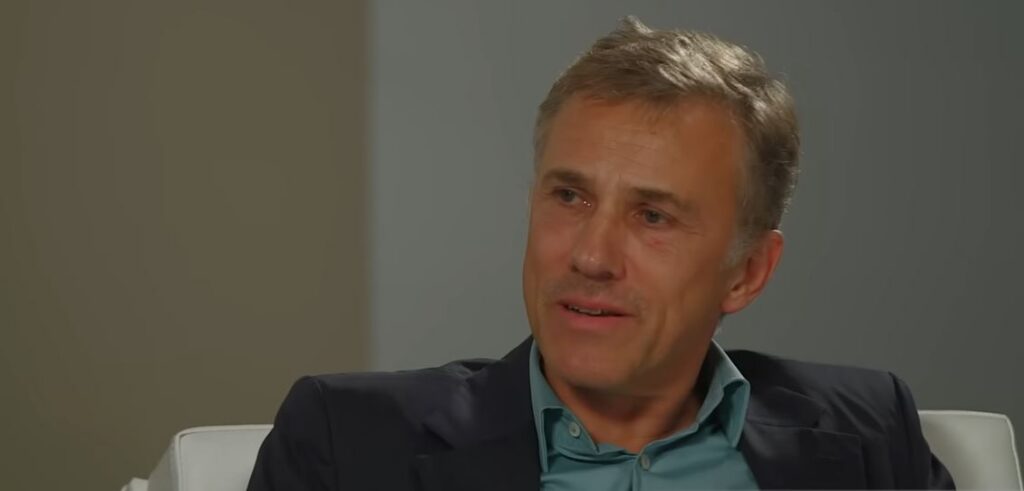
Like the characters he plays, Christoph Waltz’s ascent to financial prominence has been remarkably calculated. His $20 million estimated net worth, verified by Celebrity Net Worth, is the result of decades of accuracy, self-control, and perseverance. Waltz was a well-respected but modest figure in European theater for the majority of his early years, frequently receiving little international notice while performing in Zurich, Salzburg, Vienna, and Cologne. However, those early years laid the groundwork for a career that would eventually gain international recognition and serve as a magnificent example of perseverance paying off.
Waltz was already in his fifties when he was chosen by Quentin Tarantino to play Colonel Hans Landa in Inglourious Basterds (2009). That performance was a revelation rather than just a role. He won an Oscar, a Golden Globe, and a BAFTA for the role, which instantly made him one of Hollywood’s most in-demand character actors. He entered a new financial orbit as a result of the movie’s success, which was further cemented when he played Dr. King Schultz in Django Unchained (2012). His ability to make evil endearing and intelligence dangerous—qualities that audiences found both unnerving and alluring—was demonstrated in both roles.
| Bio Detail | Information |
|---|---|
| Full Name | Christoph Waltz |
| Date of Birth | October 4, 1956 |
| Age (2025) | 69 years |
| Birthplace | Vienna, Austria |
| Citizenship | Austria, Germany, and United States (since 2020) |
| Occupation | Actor, Director, Writer, Producer |
| Active Years | 1977 – Present |
| Spouses | Jacqueline Rauch (divorced), Judith Holste (current) |
| Children | 4 |
| Notable Works | Inglourious Basterds, Django Unchained, Spectre, No Time to Die, Big Eyes |
| Major Awards | 2 Academy Awards, 2 BAFTA Awards, 2 Golden Globes, Cannes Best Actor |
| Estimated Net Worth (2025) | $20 Million |
Over the next ten years, Waltz’s filmography significantly grew. He appeared in big-budget films like Spectre and No Time to Die, where his portrayal of Blofeld gave the James Bond films a sophisticated edge. He appeared in television shows like Only Murders in the Building, voiced characters in Guillermo del Toro’s Pinocchio, and portrayed nuanced characters in Big Eyes and The Consultant. Each carefully selected project added to a career that was both financially and artistically fulfilling.
Waltz amassed his fortune via the art form itself, in contrast to actors who mainly depend on commercial endorsements. Estimates of his earnings per major production range from $2 million to $5 million, which reflects his selectivity and prestige. Keeping creative control has been especially facilitated by this financial strategy. He has directed movies like Wenn man sich traut and Georgetown, and these endeavors have significantly increased his long-term income through production shares and residuals—a business model that is similar to that of Ben Affleck and George Clooney.
Waltz has built a portfolio that is both varied and long-lasting by fusing artistic integrity with sound financial management. In addition to acting, he also directs, produces, and even provides voice acting for animation. This equilibrium has proven to be very effective in maintaining stability in a sector that is frequently characterized by unpredictability. His sophisticated on-screen persona, multilingualism, and European sensibility have kept him relevant in the increasingly globalized entertainment industry.
According to The Express, Christoph Waltz is ranked alongside actors like Rami Malek and Javier Bardem as the most wealthy Bond villains. He may not be the wealthiest person on the list, with an estimated net worth of $20 million, but his wealth has a deeper meaning: it is a tale of tenacity, intelligence, and the long game of artistic mastery. Ironically, his late entry into the spotlight in Hollywood has maintained his value and mystique. Waltz keeps developing, honing his craft with each new project, while others burn bright and fade.
The growing appreciation for character actors who prioritize substance over spectacle is another cultural trend that is reflected in his financial story. A renewed appreciation for performances that possess emotional intelligence instead of just star power has been demonstrated by audiences in recent years. Waltz’s delicate delivery and tastefully understated style have established a standard for this change. His depictions of antagonists frequently evoke the feeling of watching a chess grandmaster—calculated, cunning, and effortlessly in control. His signature is his intellectual prowess, which directly correlates to his potential for long-term financial gain.
Comparing Waltz’s career to that of his contemporaries in German cinema is especially fascinating. Waltz waited until his craft was completely developed, whereas Daniel Brühl entered mainstream Hollywood at a young age. As a result, the career path has been exceptionally successful in terms of both critical and financial success. By striking a balance between high-budget Hollywood productions and European art films, he has considerably lowered the risk of typecasting. This dual strategy has kept both his income and reputation remarkably steady.
From a personal perspective, Waltz’s pragmatic philosophy appears to be the source of his financial stability. He grew up surrounded by art without being overly extravagant because his mother was a costume designer and his father was a set designer. His moderate lifestyle was probably influenced by that early exposure. Despite splitting his time between Los Angeles, Berlin, and Vienna, he maintains a modest public image. No brand empires, no social media spectacle, no expansive estates showcased in tabloids—just a man whose wealth subtly reflects his work ethic.
Waltz has also embraced streaming platforms in recent years, which has been a particularly creative move for seasoned actors in the industry. Recurring royalties and a wider audience reach are offered by projects on Amazon and Hulu, ensuring revenue that is substantially quicker and more reliable than traditional box office returns. This calculated move to digital platforms demonstrates his awareness of the changes in the entertainment sector and his continued flexibility.
Christoph Waltz’s journey teaches young actors a lesson that is remarkably similar to those found in entrepreneurship: patience and accuracy frequently outperform hype and haste. His financial successes are the result of consistent growth rather than abrupt upswings. He has made acting a long-term career rather than a temporary one by giving priority to parts that fit his intellectual style.
His financial story is elegant in its simplicity: Waltz has made money through hard work, made investments through cunning, and stayed afloat through self-control. His $20 million fortune is the product of well-considered choices, each as thoughtful as his performances, rather than flamboyance. Christoph Waltz is still incredibly dependable in a field where unpredictability is common, both as a professional and an artist whose achievements never cease to inspire.